
Float switches for industrial applications, mechanical engineering, hygiene technology, and OEMs


Float switch for level detection, low-level indication, and dry-run protection.


Float switches for design, procurement, and mass production
In many applications, it affects design, installation effort, process reliability, and maintenance.
That is why we consider not only the sensor itself, but your entire application:
medium, temperature, pressure, installation orientation, switching points, connection, quantity, testing requirements, and subsequent mass production.
For Design Engineers
Customization of overall length, switching points, materials, and threads for seamless integration into your assembly. CAD data is available upon request.
For Technicians
based on medium, temperature, pressure, installation orientation, and switching function. Includes a sample for installation and functional testing, if required.
For Buyers
Mass production in Germany, high vertical integration, ISO-certified processes, and RoHS- and REACH-compliant products for predictable procurement.


In many cases, you’ll receive an initial technical assessment or a proposed solution within a few business days.
Technical Highlights at a Glance
Versatility
Multifunctional
Optional integrated temperature measurement, which reduces installation time and the number of interfaces.
Ready to connect
Custom-made
Float Switch Models
We’d be happy to help you choose the right one.
Vertical Series – Top-Down Installation

Plastic float switch


Metal and stainless steel versions
Horizontal Series – Side-by-Side Installation


Plastic float switch


Metal and stainless steel versions
Special Types

With temperature sensor

For drinking water
, KTW, DVGW
With Hall sensor
High switching accuracy and high number of switching cycles
5 steps to finding the right float switch:
2. Technical evaluation:
Our technicians determine which design, material, and switching function are suitable.
3. Concept and drawing:
You will receive a technical solution, with a drawing or CAD data for integration into your design upon request.
4. Prototype and testing:
For new applications, a prototype can be created for testing in your system or assembly.
If off-the-shelf products don’t meet your needs, we’ll explore a technically suitable design for your application.
Our experts in Mühlheim are ready to take on your challenge. Send us a sketch or your specifications—we’ll provide you with a technical concept within 3 days.
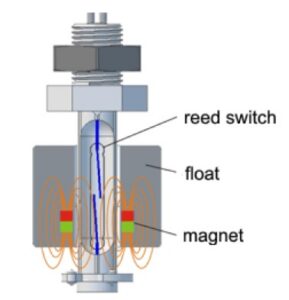
How a float switch works
Float switches compared to other level sensors
| system | benefits | disadvantages |
|---|---|---|
| Float switches | Rugged, low-maintenance, cost-effective | Mechanically operated |
| Capacitive sensor | No moving parts | Sensitive to media changes |
| ultrasound | Contactless, media-free | Higher price, prone to foaming |
Materials & Media Resistance
The final choice of material should always be based on the specific medium, concentration, temperature, and installation conditions.
What information do we need for the technical design?
| Selection criterion | Why it's important |
|---|---|
| Medium | Determines the material, float material, and chemical resistance |
| Temperature | Affects the choice of plastics, seals, cables, and electrical design |
| Relevant to design, sealing performance, and mechanical stress | |
| installation position | Vertical, horizontal, suspended, or custom installation |
| Tank material and wall thickness | Important considerations regarding threads, gaskets, mounting holes, and installation |
| Switching points | Min., Max., Empty/Full, or multiple defined levels |
| Switching function | Normally open, normally closed, or reversible function |
| Electrical load | Voltage, current, relay control, PLC input |
| Connection | Wire, cable, connector, special connector, or pre-assembled cable |
| Quantity / Project Phase | Prototypes, small-batch production, mass production, frame requirements |
No problem. Send us your sketch, a photo, a drawing, or the key specifications—our technicians will determine the right design for you.
Areas of application for our float switches
Industries
Examples of use
- for reliable empty signaling and dry run protection in sensitive processes.
- for monitoring minimum/maximum levels and for protection against overheating or cavitation.
- in conjunction with suitable materials for drinking water and hygiene-critical media
Technical Inquiry Regarding Your Application
Do you have a specific challenge?
Talk directly to our technicians in Mühlheim. We’ll find a solution where standard catalog products fall short.
Technical Inquiry
Send us your requirements, a drawing, a photo, or the key specifications.
We'll determine whether a standard solution is sufficient or if a custom design is the better option.

No problem. We'll work with you to determine what information is needed.
Frequently asked questions - brief answers
What is a float switch?
A float switch is a level sensor that detects a specific liquid level. A float with a built-in magnet moves with the liquid level and activates a reed switch without physical contact. This allows an electrical circuit to be opened or closed, for example, for pump control, low-level indication, high-level indication, or dry-run protection.
How does a float switch work?
The float moves along a riser tube or within a defined guide as the liquid level rises or falls. There is a magnet inside the float. As soon as the float reaches the defined switching point, the magnet activates a reed switch inside the sensor.
The advantage: The reed switch is activated without physical contact. As a result, there is no direct mechanical wear on the contact. This makes float switches low-wear, robust, and suitable for many mass-production applications.
For which types of media are float switches suitable?
That depends on the medium, temperature, concentration, pressure, and material requirements. It is crucial that the float, seals, and all parts that come into contact with the medium are chemically and mechanically compatible with the application.
Typical media include water, oils, coolants, cleaning agents, diluted acids and alkalis, as well as select food or drinking water applications using suitable materials.
What technical specifications are particularly important for float switches?
The following information is particularly relevant for the technical design:
- Medium
- Density of the medium
- Temperature range
- installation position
- Tank material and wall thickness
- desired switching point
- Switching function: normally open or normally closed
- electrical load
- Connection type
- Number of units or project phase
The more accurate this data is, the more reliably the appropriate model can be selected.
Can the switching point of a float switch be adjusted?
Yes. The switching point can be adjusted depending on the design, mounting orientation, and application. To do this, we need the desired switching height, the mounting configuration, and the mechanical constraints.
If there are multiple levels, models with multiple switching points are also available.
What are the installation options for float switches?
Float switches can be installed in different ways depending on their design:
- vertically from above
- vertically from the bottom
- horizontally from the side
- in custom assemblies, depending on the container or assembly
It is important to ensure proper sealing, sufficient room for the float to move, and the correct installation position for the desired switching function.
What is a plastic float switch suitable for?
Plastic float switches are suitable for many applications involving moderate temperatures and compatible fluids. They are lightweight, corrosion-resistant, and cost-effective.
Typical applications include water tanks, cleaning agents, coolants, dosing systems, and—depending on the material—drinking water or hygiene technology.
When is stainless steel a better choice than plastic?
Stainless steel is a good choice when higher temperatures, higher mechanical loads, corrosive media, or specific requirements for robustness and durability are present.
Plastic is often more cost-effective when the medium, temperature, and mechanical stress are suitable for its use.
How many switching points are possible?
Typically, a single component has one to three switching points. The number of switching points depends on the design, the length of the riser tube, the size of the float, the installation orientation, and the desired switching range.
Special versions with additional switching points can be tested.
When is a custom float switch a good idea?
A custom design is recommended when standard switches do not meet the requirements for installation space, medium, temperature, switching point, connection type, mounting, or series integration.
Typical customizations include overall length, material, thread, cable length, connector, switching function, or multiple switching points.
Can float switches be retrofitted?
Yes, retrofitting is possible in many cases. To determine this, the installation conditions, the material of the enclosure, the wall thickness, the sealing, the electrical interface, and the available mounting opening must be checked.
For existing systems, a customized design is often advisable.
How do you connect a float switch?
The switch contact is connected to the system via wires, cables, connectors, or a pre-assembled cable. Depending on the application, the float switch can send a signal to a controller, a relay, or a signal processing unit.
Key factors include voltage, current, switching capacity, protection rating, and the application's electrical interface.
Are custom-made products possible?
Yes. Possible adjustments include, among other things, changes to the material, overall length, mounting position, switching point, cable length, connector, thread, seal, and switching function.
For new applications, a prototype can first be created for installation and functional testing.
How does a typical project work?
First, please send us the key technical specifications, such as the medium, temperature, installation conditions, set point, connection type, and quantity.
Our technicians then evaluate the appropriate design, the suitable material, and the technical feasibility. If necessary, we create a prototype with drawings or CAD data. Once testing and approval are complete, mass production can begin.
Where is the float switch installed?
The float switch is installed in a container, tank, or technical assembly. Depending on the design, it can be installed from the top, the bottom, or the side.
The key factors are the installation space, sealing, the float's range of motion, and the desired switching height.
What is a level switch?
A level switch monitors a defined liquid level. The term is often used as a general term for sensors that detect a level and output an electrical signal.
Float switches are a type of level switch. They operate using a movable float and a magnetically actuated reed switch.