
Suction lances with float switches for removing media from containers
The suction lances combine media extraction with an empty signal in a compact assembly.
They are customized to the specific tank, medium, connection, switching point, and production run requirements.
Suction lances with integrated level control
The built-in float switch signals a low level or empty container and protects metering pumps from running dry.
For designers, mechanical integration, material selection, immersion depth, connection type, and switching point are key considerations.
For buyers, reproducible quality, technical coordination, sample provision, and predictable series delivery are priorities.
We manufacture suction lances for industrial applications—tailored to the medium, container, metering pump, and electrical interface.
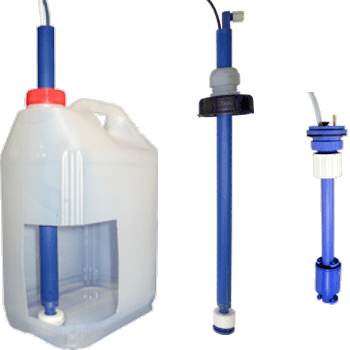
How is a suction lance constructed?
Selection by container and application
| Usage | Typical requirement | Relevant version |
|---|---|---|
| 5–60-liter canister | Compact design, lid adapter, small residual amount | PE/PP suction lance with canister lid |
| Barrel (approx. 200 L) | greater immersion depth, secure mounting | longer suction lance with drum adapter |
| IBC container | Tall container, sturdy removal | IBC suction lance with a customized connection |
| Chemical dosing | Media compatibility, low-level alarm, backflow preventer | Suction lance with float switch and PE/PP material |
| Multi-point monitoring | empty/full or min/min-min | Suction lance with multiple switching points |
Examples of suction lances

- Suitable for many container openings
- Various lengths available

- Immersion depth freely adjustable
- Electrical connection via M8x1 plug

- High absorption rate
- Very good chemical resistance

- Excellent chemical resistance
- Available in various lengths

- Immersion depth freely adjustable
- Available in various lengths

- Required container opening only 22 mm
- With hose connection

- With hose connector
- Various lengths available

- Various connections for your suction hose
- Available in various lengths
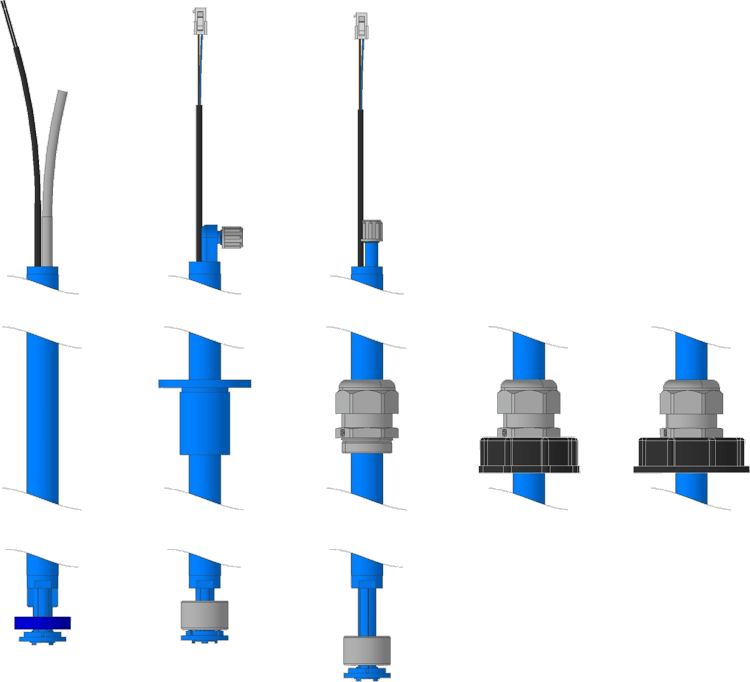
Custom-made suction lances – modular system
That is why our suction lances are mechanically and electrically customized to meet your requirements—from length and canister closures to hose connections and switching points. The result is a solution that integrates seamlessly into your design and ensures stable processes and predictable operating costs over the long term.
Modular system
Typical areas of application
Advantages of suction lances with float switches
Suction lance for dispensing chemicals, cleaners, and process media

Why choose Binsack Reedtechnik for suction lances?
For suction lances, Binsack offers technical consulting, sample provision, custom design, and series production.
Our suction lances are specifically designed for use in dosing systems and chemical processes.
Our experts will help you select the right model for canisters, drums, or IBC containers.
What information is helpful for the design?
- Container type: canister, drum, tank, or IBC
- Container height and opening / lid thread
- Medium and chemical resistance
- Desired immersion depth
- Suction connection and hose diameter
- Desired switching point for empty signal
- Electrical interface / connector / cable length
- Quantity, sample requirements, and production requirements
Direct Contact with Technical Support

Frequently asked questions about our suction lances
What is a suction lance?
A suction lance is a system for extracting liquids from canisters, barrels, or IBC containers. It is used to safely convey media such as chemicals, water, cleaning agents, or cooling lubricants while simultaneously monitoring the fill level. Suction lances are typically used in dosing systems, pump systems, and industrial machines.
Why is a float switch useful in the suction lance?
An integrated float switch prevents a dosing pump from running dry. As soon as the liquid level becomes too low, a signal is triggered.
How does a suction lance with float switch work?
The suction lance extracts the medium via an integrated riser pipe. A built-in float switch monitors the liquid level in the container. If the level falls below a defined point, the reed contact switches and reports "container empty" or "refill required" to the control system or pump.
How is a suction lance constructed?
The suction lance consists of:
-
Lance: Inserted into the container, reaches the bottom, and is used to extract the liquid.
-
Connection piece: For hose connection to the dosing pump or similar.
-
Level sensor: Usually integrated in the lower area of the lance.
-
Non-return valve (optional): Prevents backflow.
-
What information is needed to design a suction lance?
The following factors are important for the design: medium, tank type, tank opening, immersion depth, desired switching point, connection type, electrical interface, temperature range, flow rate, and planned quantity.
What is a suction lance suitable for?
Suction lances enable the easy removal of liquids from dosing containers or canisters with simultaneous container empty detection. They are also sometimes referred to as suction fittings.
What advantages does a suction lance offer over separate level sensors?
A suction lance combines media extraction and level detection in a single component. This reduces installation effort, additional openings in the container, and potential leak points. It also simplifies integration into existing plants and control systems.
For which media are the suction lances suitable?
Binsack Reedtechnik suction lances are suitable for many liquid media, including:
-
Chemicals and additives
-
Cleaning agents and disinfectants
-
Water and process fluids
-
cooling lubricants
The choice of material (e.g., PP or PE) depends on the medium and its chemical properties.
-
In which containers can suction lances be used?
Suction lances are suitable for:
-
canister
-
barrels
-
IBC container
Length, mounting, and connections are adapted to the respective container geometry so that safe removal is possible down to a low fill level.
-
Can I retrofit the suction lance?
Yes, retrofitting is possible in many cases. To do so, the tank opening, immersion depth, mounting, hose connection, electrical interface, and medium must be checked.
How is the suction lance connected electrically?
The fill level is detected via potential-free reed switch contacts. These can be connected directly to pumps, relays, or industrial control systems (e.g., PLCs). This makes integration simple and reliable.
How is the media connection made?
Optionally with integrated hose or hose connection plug or screw connection for your hoses.
Can the suction lance be customized?
Yes. Our suction lances are often customized. Adjustments are possible for, among other things:
-
Total length of the suction lance
-
Switching point(s) of the float switch
-
Hose and threaded connections
-
Additional components such as filters or check valves
-
How does a typical project work?
-
Inquiry & key data - You tell us the medium, container type, temperature range, desired withdrawal quantity, switching points and quantities.
-
Technical coordination - we clarify mechanical and electrical interfaces directly with your development team.
-
Samples & testing - You will receive samples and technical documentation for testing in your system.
-
Release & series - after successful testing, we deliver in series in accordance with the framework agreement or call-off planning.
In this way, we ensure that the suction lance, container and system work together optimally - both technically and logistically.
-
Are the suction lances manufactured in Germany?
Yes. Development and manufacturing take place in Germany. This guarantees consistent quality, short coordination channels, and high delivery reliability.
What is a metering suction lance?
A suction lance (suction assembly) is used to safely and accurately pump liquids out of canisters, drums, or IBC containers. As the link to the metering pump, it ensures that chemicals are transferred cleanly and accurately.
What information does Binsack need to design a custom suction lance?
1. Information about the container (canister, drum, or IBC container)2.Immersion depth: The exact distance from the bottom of the container to the top edge of the opening.3. Thread size: The exact designation of the cover or manhole4. Information about the medium (liquid)5. Temperature: Maximum operating temperature of the fluid.6. Connection details (hose size, connection type)7. Electrical Specifications (Switching function, number of switching points)8. Cable assembly (cable length, connector type)