
Custom Float Switches: Engineering & Manufacturing “Made in Germany”


A development partner, not just a supplier: Technical design tailored to your application
We know that standard solutions often reach their limits. That’s why we develop float switches specifically for your application.
You choose: material, switching points, mounting position, and connection—tailored to your application. We actively support you in the design process and offer prototyping and sample production for your test series.
and we’ll design the right float switch for you.
Free of charge and handled directly by our technicians.


Certified quality for demanding industries
For Design Engineers
Customization options include: overall lengths, switching points, and materials (PP, PA, V2A/V4A stainless steel).
We can provide CAD data at short notice.
For Technicians
Reed switch technology with no mechanical wear.
High switching reliability:
several million cycles—even in aggressive media.
For Buyers
We manufacture in Mühlheim, and our high level of vertical integration ensures short lead times and the highest quality.
ISO 9001 and ISO 14001 certified
Products: RoHS and REACH compliant


Send us a sketch or your specifications—we’ll provide you with a technical proposal within 3 days.
Technical Highlights at a Glance
Versatility
Suitable for food contact (DVGW/KTW-compliant),
thanks to the use of suitable materials
Multifunctional
Ready to connect
We assemble connectors, custom cables, or stranded wires according to your specifications, ready for installation in your production process.
Custom-made
Do you need a specific thread type (NPT, G, metric) or a suspended mounting? We can accommodate your needs, even for small batch sizes.
4 steps to a customized solution:
2. Design: Our engineers create a technical design (including CAD data).
3. Prototyping: Rapid prototyping for validation in your application.
4. Series Production: Reliable production and delivery “Made in Mühlheim”.
"We don't do 'that won't work.'"
Our experts in Mühlheim are ready to take on your challenge. Send us a sketch or your specifications—we'll provide you with a technical concept within 3 days.
How a float switch works
Float switches vs. other level sensors
| system | benefits | disadvantages |
|---|---|---|
| Float switches | Rugged, low-maintenance, cost-effective | Mechanically operated |
| Capacitive sensor | No moving parts | Sensitive to media changes |
| ultrasound | Contactless, maintenance-free | Higher price, prone to foaming |
Technical specifications

Plastic float switch

Metal and stainless steel versions

With integrated temperature sensor
Materials & Media Resistance
Water, oils,
Coolants,
Chemical liquids
Food-grade media (depending on the model)
Selection criteria: Which float switch is the right one?
Just tell us the medium, temperature, pressure, installation position, and quantity—and we’ll determine the technically suitable float switch for you. Free of charge, handled directly by our technicians, usually within two business days.
Areas of application for our float switches
Industries
Examples of use
- for reliable empty signaling and dry run protection in sensitive processes.
- for monitoring minimum/maximum levels and for protection against overheating or cavitation.
- in conjunction with suitable materials for drinking water and hygiene-critical media
How to Find the Sensor You Need
Do you have a specific challenge?
Talk directly to our technicians in Mühlheim. We’ll find a solution where standard catalog products fall short.
Contact – Direct & Competent.

Product overview
Detailed technical data for each item is available on request.
We can modify any type to your requirements on request.

- For liquids with a low density from 0.65 g/cm³
- Reversible switching function

- For many liquids
- Inexpensive

- 3 switching points
- Slim design

- Suitable for aggressive liquids
- Electrical connection via standard M12x1 socket

- Angled Superseal plug
- Ideally suited for oils

- Protected float (anti-slosh protection)
- Suitable for aggressive liquids

Frequently asked questions - brief answers
What is a float switch?
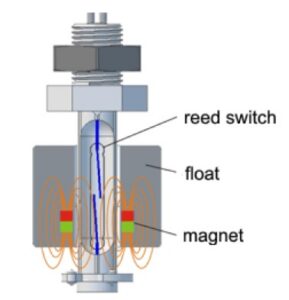
A level sensor that activates a reed switch via a permanent magnet float. It closes a circuit at a predetermined level—for example, to control a pump or trigger an alarm.
How do float switches work?
A magnetic float floats in the liquid and moves along a riser tube with the liquid level. The magnet in the float actuates a reed contact in the riser tube without contact at a defined liquid level. Advantage: very favorable, for many liquids. As the reed contact is switched without contact, there is no mechanical abrasion - ideal for long series running times with minimum maintenance.
What is a plastic float switch suitable for?
For many applications with medium temperatures (up to 80°C) that must be corrosion-resistant and hygienic - e.g. in drinking water technology for water level monitoring. For switching pumps via relays.
How many switching points are possible?
Depending on the length of the riser pipe. Typically: 1 to 3 switching points. Special versions with more switching points are available upon request.
Can I retrofit the float switches?
Yes, our level switches are mechanically and electrically compatible - even for existing systems.
What installation options are there for float switches?
There are vertical float switches for installation from above in the tanks. Alternatively, there are horizontal level switches for installation from the side in the water tank. With these, care must be taken to ensure that they are screwed tightly so that no liquid leaks out.
How do you connect float switches?
The switch contact of the level switch is connected to your system via a cable or stranded wire. The switch contact is potential-free and is available in various power and voltage classes. The stranded wires are available either stripped, with ferrules, with a plug, or with a special connector—always perfectly suited to your technology.
Are custom-made products possible?
Material, mounting orientation, cable length, connection, and switching function—everything is tailored to your application. Samples available upon request; production runs starting from a minimum order quantity of 1.
How does a typical project work?
-
Your inquiry with key data on medium, temperature, container and quantities
-
Technical coordination directly with our development team
-
Prototyping including drawing and documentation
-
Testing and release in your system
-
Series delivery according to framework agreement or call-off plan
-
Where is the float switch located?
The float switch is installed in containers or tanks. It is screwed into the container through an opening.
Can be mounted from above or below, as well as from the side.